Research

A beyond-equilibrium framework for quantum matter

We establish a feedback loop between advanced optical spectroscopy and device engineering to reveal, control, and stabilize emergent quantum phases.

Experimental platform

Time-resolved pump–probe microscopyRaman scatteringtr-SHGtr-KerrPhotoluminescenceSingle-photon correlations
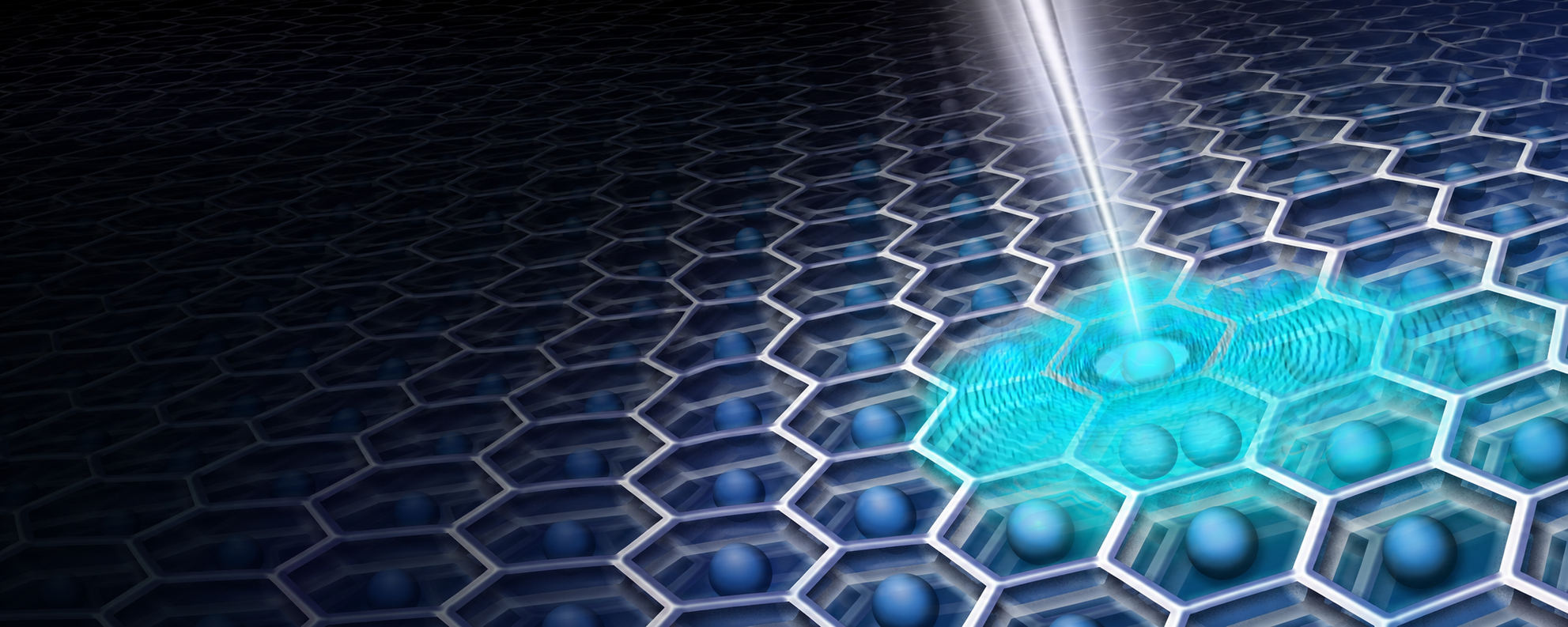
Ultrafast excitation of a moiré quantum material
01

Time-domain exploration of topological moiré phases

How do hidden quantum states form, compete, and become controllable?

Moiré materials provide a tunable setting for strongly correlated and topological phases, including candidate fractional and non-Abelian states at zero magnetic field. We use nonequilibrium spectroscopy to follow their microscopic evolution directly in time.

  1. Reveal hidden correlated and topological states in twisted WSe₂ through time-resolved exciton sensing.
  2. Resolve competing-order and pairing dynamics in trilayer and rhombohedral graphene superconductors.
  3. Image domains and drive topological transitions using circular light, Kerr rotation, and circular dichroism.

Initial systems tWSe₂ · tMoTe₂ · trilayer graphene · WTe₂ · TaIrTe₂

Collective excitation driven by ultrafast light
02

Unconventional ferroic order and collective modes

Can collective excitations identify and switch order beyond conventional magnetism?

Ferro-axial, ferro-toroidal, altermagnetic, and complex multiferroic phases carry vector and multipolar order parameters that are often difficult to see with static probes. Their collective modes provide a symmetry-sensitive route to both detection and control.

  1. Identify hidden ferroic orders using time-resolved SHG and polarization-resolved Raman spectroscopy.
  2. Track and optically switch degenerate ferroic states with circularly polarized ultrafast pulses.
  3. Design new ferroic textures through stacking, twisting, and symmetry engineering in vdW heterostructures.

Initial systems CoI₂ · EuIn₂As₂ · EuTe₄ · Fe₃GaTe₂ heterostructures

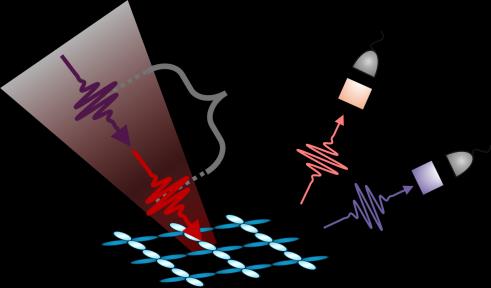
Quantum-correlated Raman photon detection concept
03

Quantum optics integrated with quantum materials

What new information appears when spectroscopy reaches the single-photon level?

We connect quantum materials to integrated photonics in two directions: using layered nonlinear materials as compact quantum-light sources, and using photon correlations as a new probe of many-body electronic and spin correlations.

  1. Create on-chip entangled-photon sources using quasi-phase-matched layered ferroelectrics.
  2. Develop quantum-correlated Raman spectroscopy with HBT detection of g²(τ).
  3. Access electron- and spin-mediated correlations encoded in individual Raman-scattered photons.

Initial systems NbOI₂ · 3R-MoS₂ · correlated and topological quantum materials

Long-term vision

From observing fragile phases to engineering quantum states on demand.

By combining ultrafast spectroscopy, nonlinear optics, quantum-correlation measurements, and optimized devices, we aim to connect correlated quantum materials with future quantum photonic and information technologies.